
Transpositions by Semitones, Diatonic, and Chromatic in Guitar Pro 8
The transposition tool in Guitar Pro, accessible via Tools > Transpose, allows you to modify the pitch of notes beyond the key adjustments in the Track Inspector.
It shifts a selected set of notes or the entire score by a specific interval, while maintaining the coherence of your music. This section explains how to use it and highlights the benefits of each transposition type.
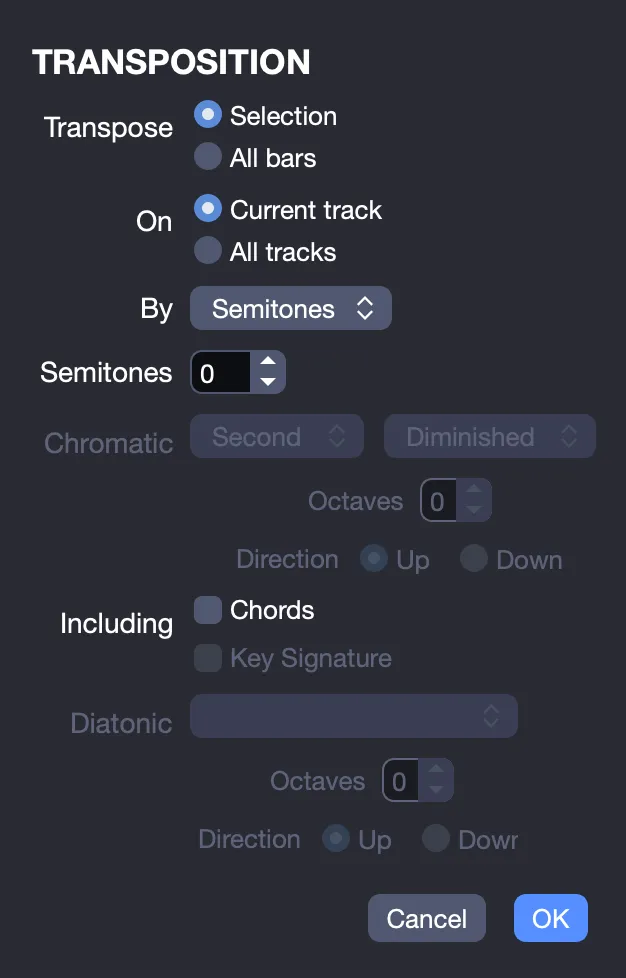
Choose your range to transpose a selection or all bars, and apply it to the current track or all tracks.
Three options are available: semitones, chromatic, and diatonic, each offering a different approach.
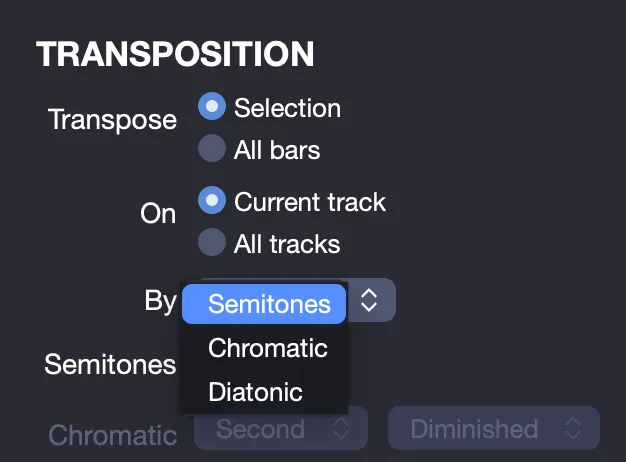
The settings adapt to the chosen method; here is their operation and utility.
Transposition by Semitones
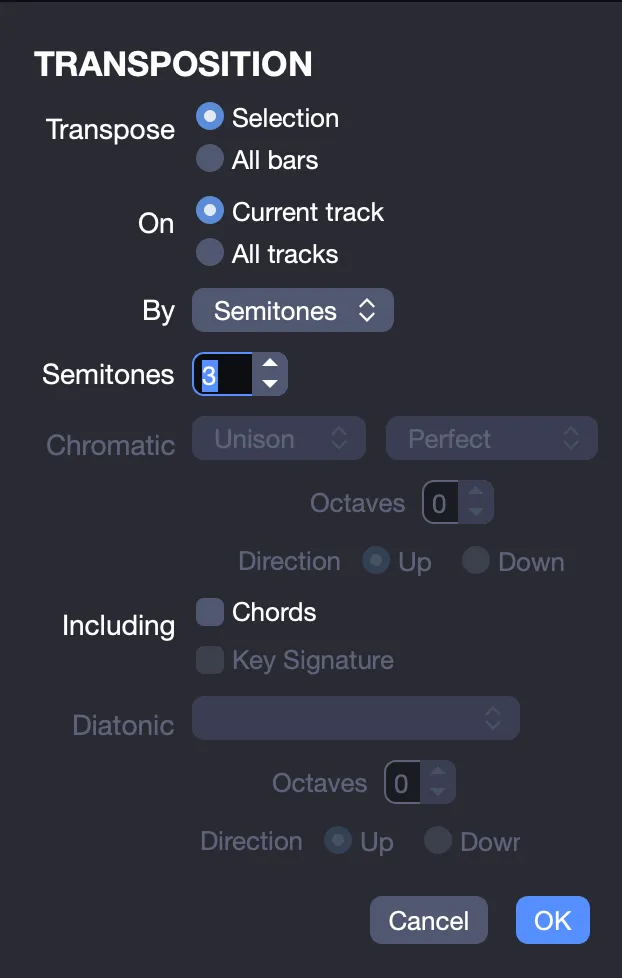
Enter a number of semitones and click OK to shift all selected notes by that value. This method is simple and straightforward: a shift of 3 semitones transforms a C into an E♭, moving everything uniformly, regardless of the key or scale.
Why use it?
Transposition by semitones is ideal for quick adjustments, independent of the key. For example, if a piece feels too low for your voice, raise it by a few semitones to match your vocal range without rewriting it. It is also perfect for experimenting with new keys suited to different instruments or moods, such as shifting a guitar part from E to G for a brighter tone.
Example
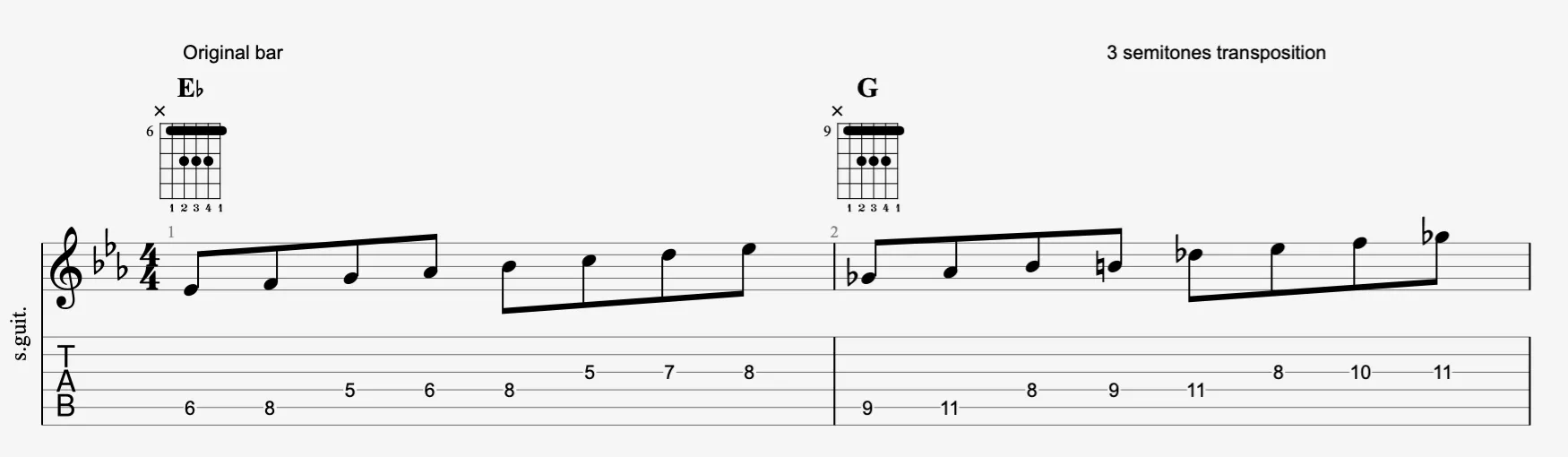
Here is a bar in C major shifted by 3 semitones to E♭ major. Check Include chord diagrams to update the chords as well, keeping your tablature aligned:
Before: C - G - Am - F
After: E♭ - B♭ - Cm - A♭
This keeps the harmonic structure intact but in a higher key, perfect for singers or capo adjustments.
Chromatic Transposition
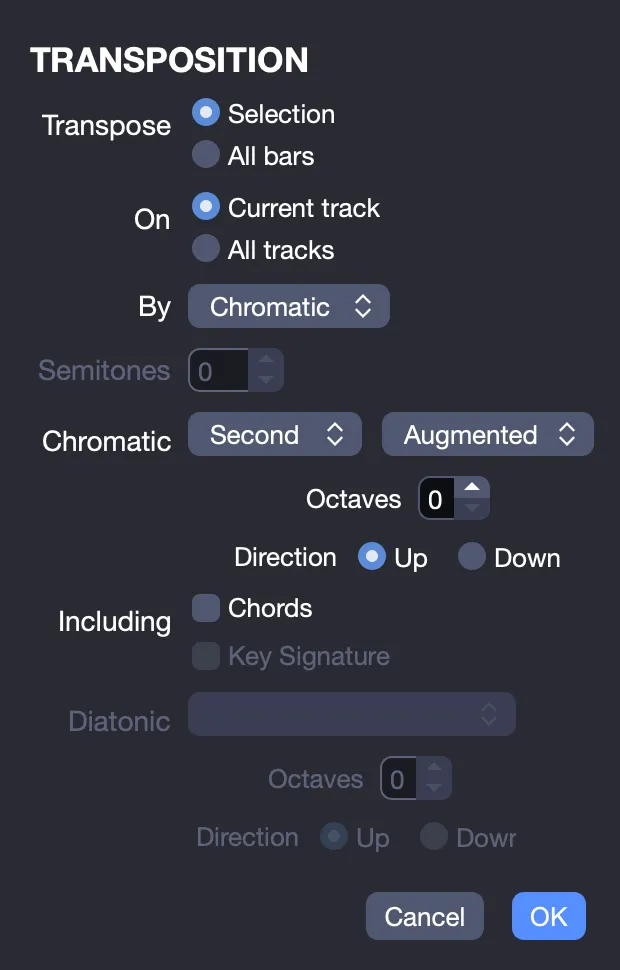
Chromatic transposition shifts notes by a specific musical interval, maintaining a constant distance without adjusting to the key. Select an interval:
- Unison (no change)
- Second (e.g., C to D)
- Third (e.g., C to E)
- Fourth (e.g., C to F)
- Fifth (e.g., C to G)
- Sixth (e.g., C to A)
- Seventh (e.g., C to B)
Then, choose its quality:
- Minor (e.g., C to E♭)
- Major (e.g., C to E)
- Perfect (e.g., C to G)
- Diminished (e.g., C to G♭)
- Augmented (e.g., C to G♯)
Define the direction (up or down) and decide if the shift extends beyond an octave.
Why use it?
This method offers precision for targeted shifts, useful for exploring harmonic variations or adapting a part for another instrument. For example, transposing a melody up a perfect fifth can align a guitar line with a brass section, preserving exact intervals. It is also handy for creating parallel harmonies, shifting a melody by a minor third to add an enchanting layer.
Example
Here is a bar shifted up by a minor third (C to E♭), with chords included:
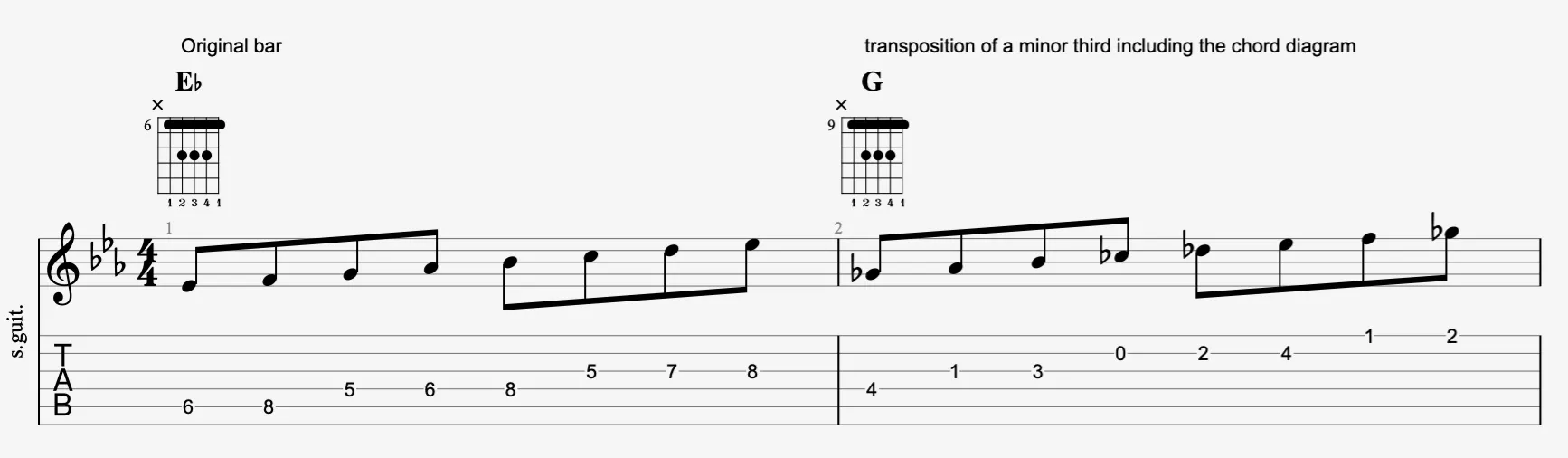
Before: C - G - Am - F
After: E♭ - B♭ - Cm - A♭
The strict interval shift preserves the melody’s shape, ideal for testing new harmonic colors.
To update the key signature as well, check Include key signature and apply to all tracks:
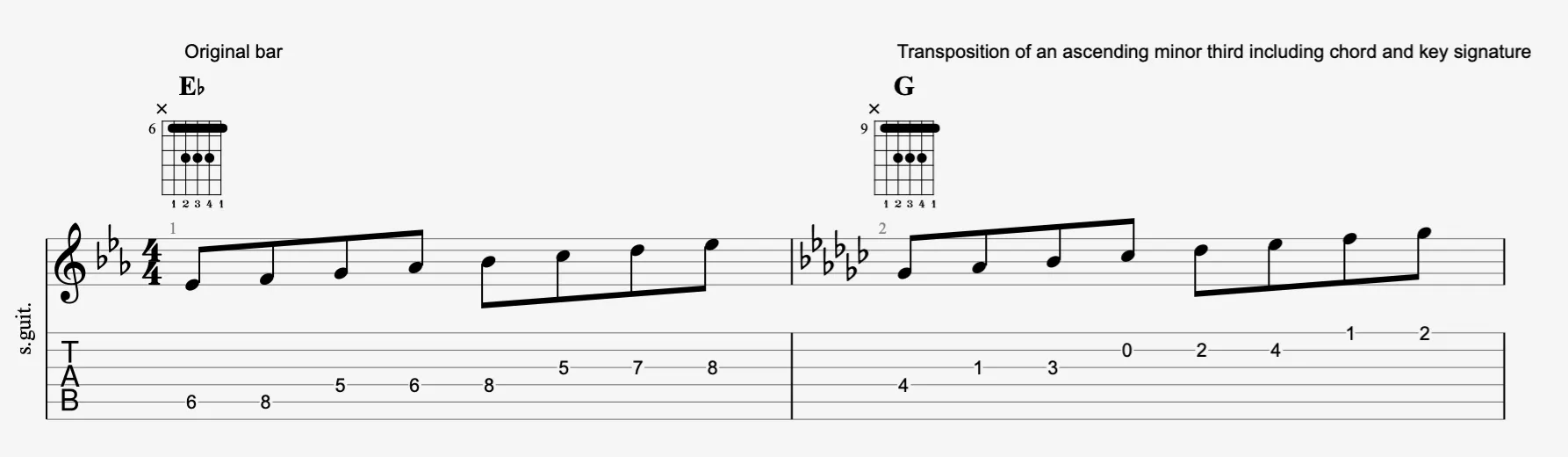
This adjusts the key from C major to E♭ major, ensuring the notation matches the new pitch, perfect for formal scores or multi-track arrangements.
Diatonic Transposition
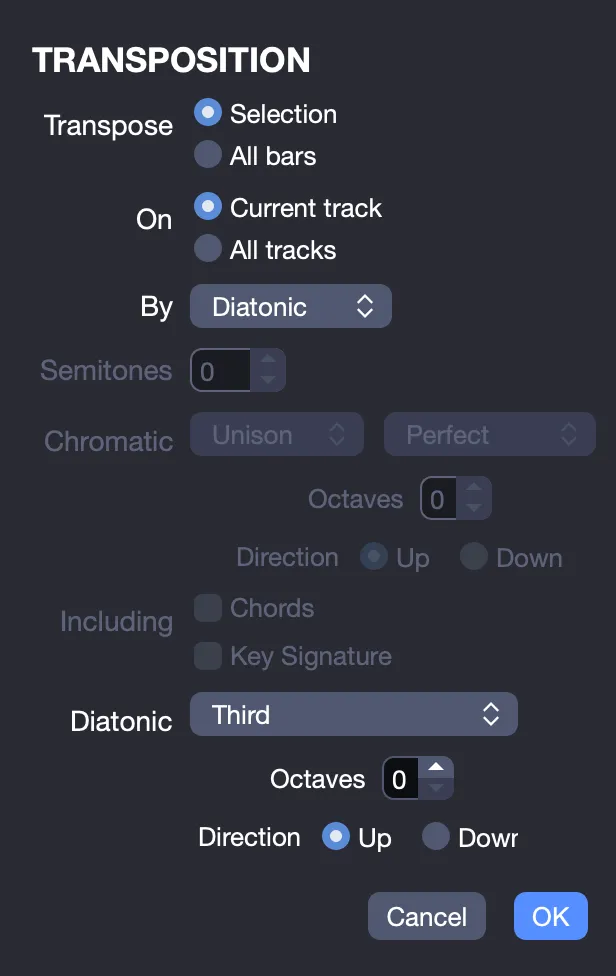
Diatonic transposition moves notes along the degrees of the current scale, staying within the key. Choose the number of scale degrees, for example, 3 degrees upward, the direction, and whether the shift crosses octaves.
Why use it?
This method keeps your music tonal, shifting notes only to valid scale degrees. It is perfect for reworking a melody or chord progression within the same key, for example, raising a vocal line to make it stand out without altering the piece’s mood. It is also useful for arranging, such as shifting a bass part by a third within the scale to complement the guitar without dissonance.
Example
Here is a bar in C major shifted up by 3 scale degrees (C to E):
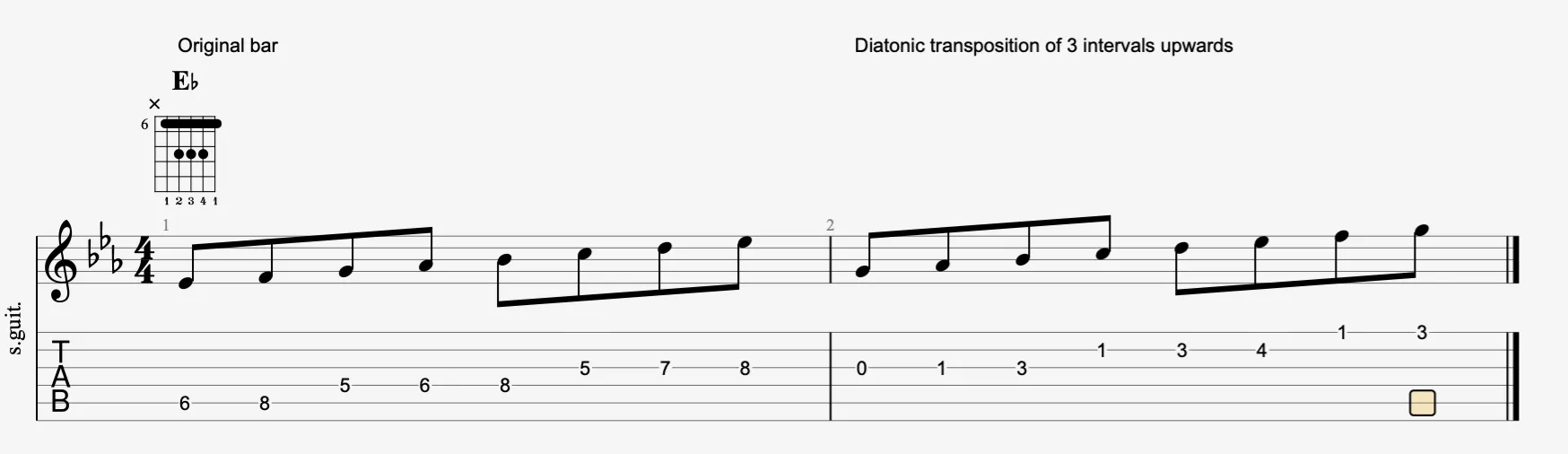
Before: C - G - A - F
After: E - B - C - A
In C major (C, D, E, F, G, A, B), C moves to E (3 degrees: C, D, E), G to B (G, A, B), A to C (A, B, C), and F to A (F, G, A). The result stays within the key, preserving the tonal structure, ideal for subtle adjustments or harmonization within the scale.
Only chord diagrams properly created from the Chord window will be transposed.
Chord names manually entered in the chord title field will not be transposed.