
Fundamentals of Musical Notation in Guitar Pro 8
To use Guitar Pro effectively, it is helpful to understand the basics of tablature and rhythmic notation, especially if you are not familiar with standard music notation.
This section presents the essential concepts required for creating and editing scores.
Tablature
Tablature is a key feature of Guitar Pro. It allows guitarists and musicians playing fretted string instruments to create and edit scores in an intuitive way.
Why Tablature?
Specifically designed for fretted string instruments, tablature offers a simple alternative to standard notation and requires little knowledge of music theory.
It indicates exactly which strings and which frets to play, making it easier to transcribe your musical ideas onto the instrument.
This precision is important, because the same note can be played on multiple strings, producing the same pitch but with different tonal characteristics.
For example, a C can be played on the 5th fret of the G string or on the 1st fret of the B string.
How to Read Tablature
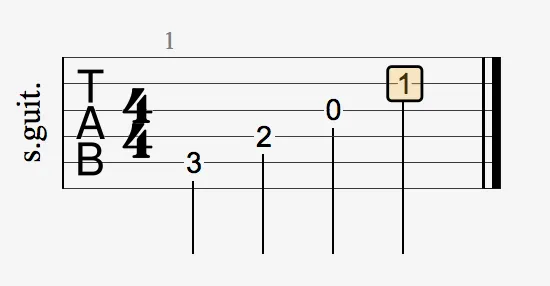
Each line of a tablature represents a string.
The lowest-pitched string is shown at the bottom, and the highest-pitched string at the top, reflecting the view of a guitarist looking at their instrument.
The numbers on the lines indicate which frets to press: a “0” means playing the open string (no fret pressed), a “3” indicates the 3rd fret, and so on.
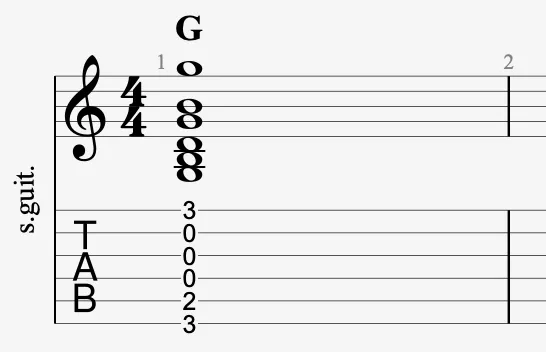
When numbers are vertically aligned, they form a chord.
Note and Rest Durations
The duration of notes determines how long each note is played within a bar.
In Guitar Pro, as in standard music notation, these durations must respect the rhythmic structure defined by the time signature.
Understanding these durations is essential for creating valid and rhythmically coherent bars.
Main Note Durations
Notes are defined by their rhythmic value, expressed as fractions of a beat.
In common notation, the quarter note is often used as the reference.
Here are the main note durations, from longest to shortest:
- Whole note: 4 beats
- Half note: 2 beats
- Quarter note: 1 beat
- Eighth note: 1/2 beat
- 16th note: 1/4 beat
- 32nd note: 1/8 beat
- 64th note: 1/16 beat
The shorter the note, the more precise the rhythmic writing can be, especially for fast passages.
Example in 4/4 Time
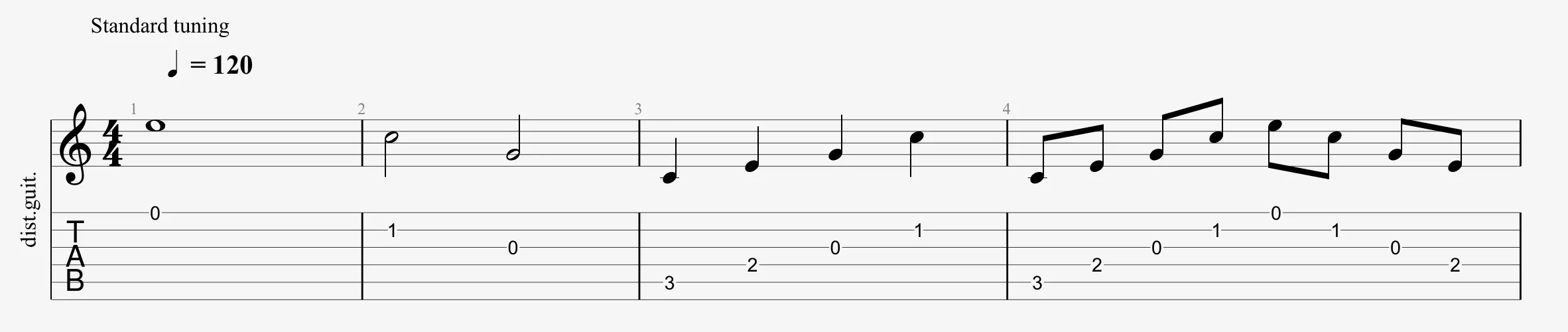
In a 4/4 bar, the bar must always contain exactly 4 beats.
Here are some valid combinations:
- 1 whole note = 4 beats
- 2 half notes = 2 + 2 = 4 beats
- 4 quarter notes = 1 + 1 + 1 + 1 = 4 beats
- 8 eighth notes = 8 × 1/2 = 4 beats
- 1 half note + 2 quarter notes = 2 + 1 + 1 = 4 beats
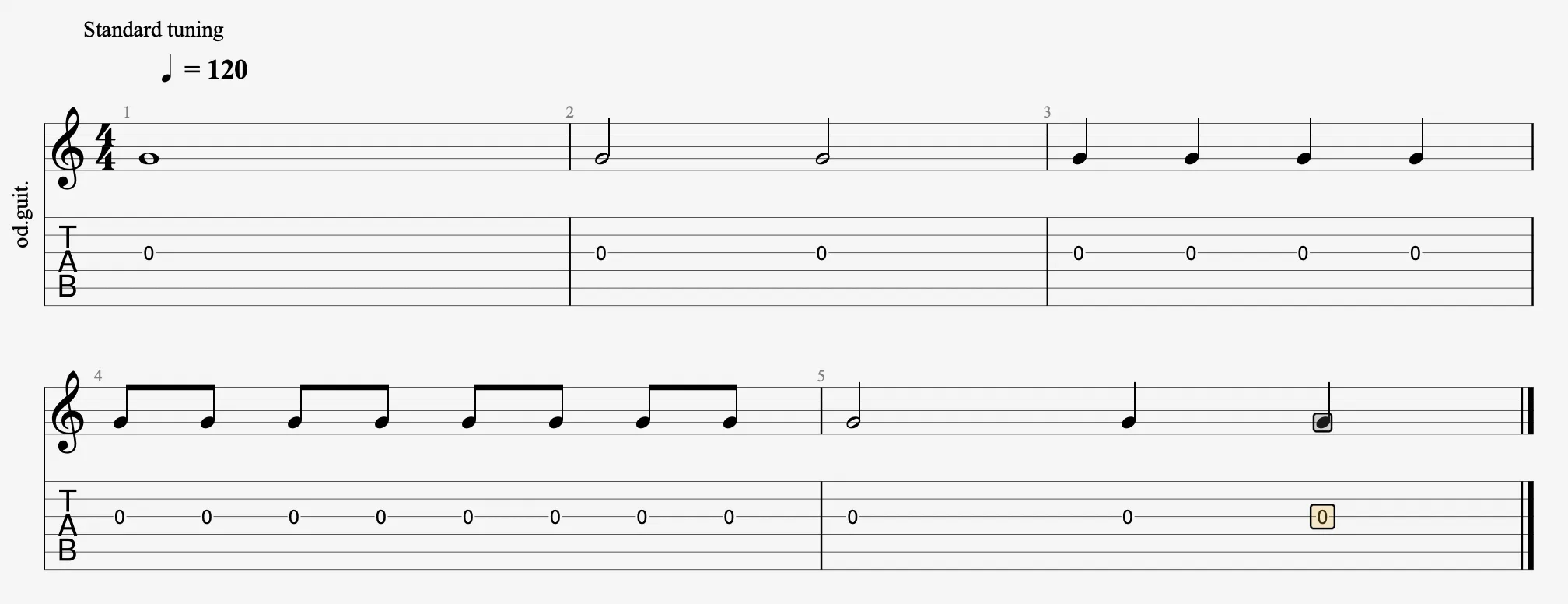
Any combination is possible, as long as the sum of the durations is correct.
Dotted Notes
A dotted note has one dot placed to the right of the note head.
Its duration is increased by half of its original value.
Common examples:
- Dotted quarter note: 1 + 1/2 = 1.5 beats
- Dotted half note: 2 + 1 = 3 beats
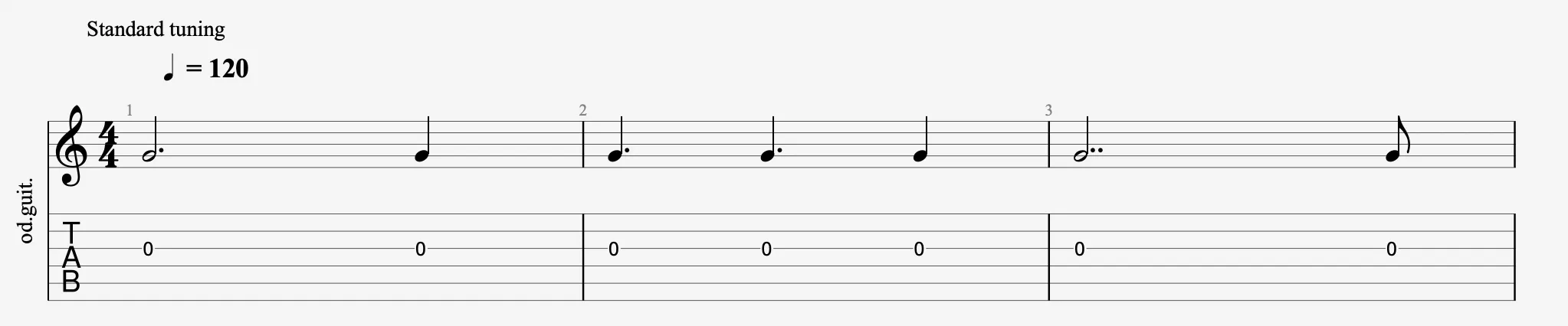
In 4/4 time, a valid bar may, for example, contain:
- 1 dotted half note (3 beats) + 1 quarter note (1 beat)
Double-Dotted Notes
A double-dotted note has two dots placed to the right of the note head.
The first dot adds half of the note’s value. The second dot adds half of the value added by the first dot.
In other words, a double-dotted note = the note’s value + 1/2 + 1/4 of its value.
Concrete examples:
- Double-dotted quarter note: 1 + 1/2 + 1/4 = 1.75 beats
- Double-dotted half note: 2 + 1 + 1/2 = 3.5 beats
In 4/4 time, a valid bar may, for example, contain:
- 1 double-dotted half note (3.5 beats) + 1 eighth note (0.5 beat)
Rests
Rests represent periods of time during which no sound is played.
They follow exactly the same rules as notes.
Each note has an equivalent rest:
- Whole rest: whole-note rest (4 beats)
- Half rest: half-note rest (2 beats)
- Quarter rest: quarter-note rest (1 beat)
- Eighth rest: eighth-note rest (1/2 beat)
- 16th rest: 16th-note rest (1/4 beat), etc.
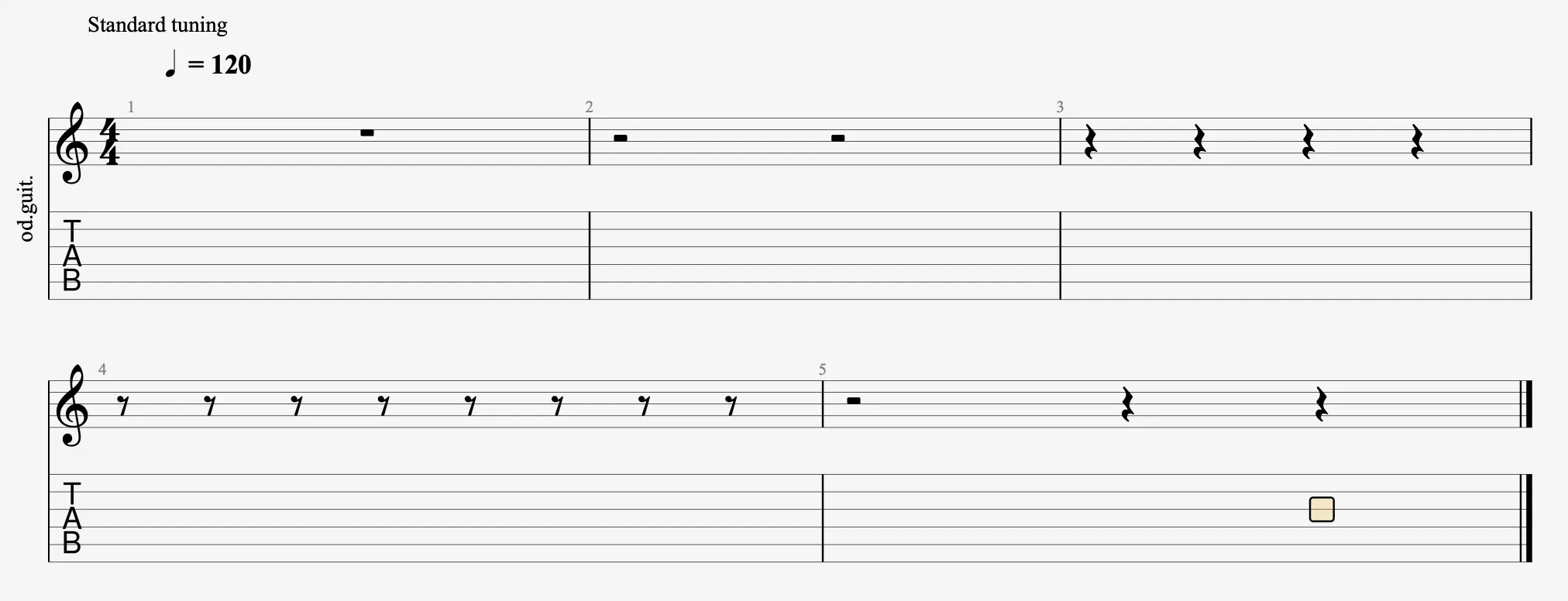
Rests are essential for structuring rhythm and allowing the music to breathe.
Valid Bars and Rhythmic Balance
In Guitar Pro, a bar is considered valid when the sum of the durations of notes and rests matches exactly the time signature.
In 4/4: - Too little duration → incomplete bar
- Too much duration → rhythmic overflow
A bar completion indicator is displayed on the LCD at the top of the window. It shows how much time remains to be filled in the current bar.
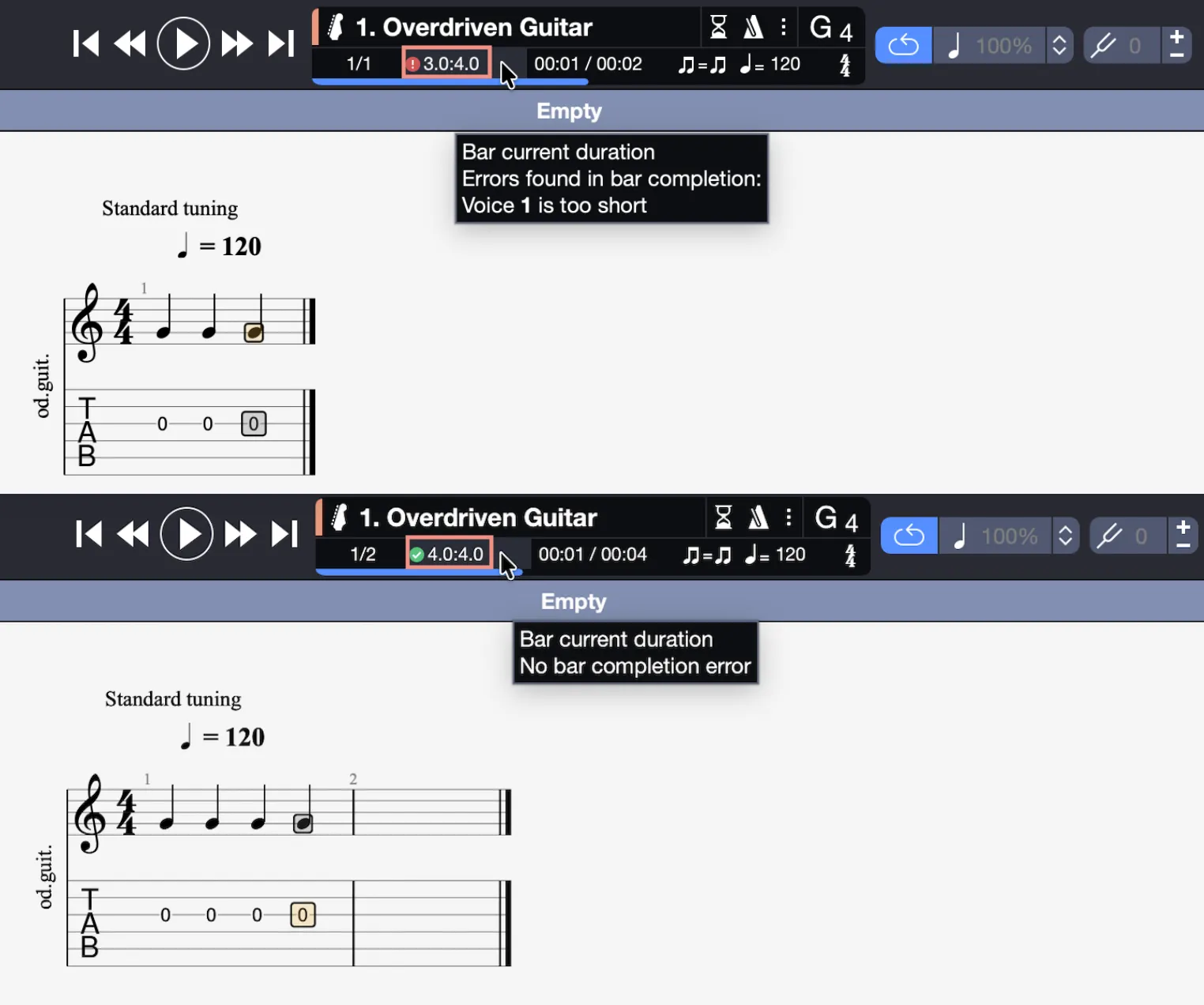
Invalid bars appear in red (if the option is enabled in the notation error preferences).
Understanding Rhythm
Rhythm is the foundation of musical timing, determining how notes fit into a composition according to the tempo. Here are the key concepts:
- Tempo: Expressed in beats per minute (bpm), tempo defines the speed of the music. For example, at 60 bpm, a quarter note lasts one second; at 120 bpm, it lasts half a second.
- Note Durations: The whole note serves as the starting point, lasting four beats. By dividing it, we obtain:
- Half note: 2 beats
- Quarter note: 1 beat
- Eighth note: 1/2 beat
These durations form the building blocks of rhythm.
- Half note: 2 beats
- Dotted Notes: A dot next to a note extends its duration by half of its value. For example, a dotted quarter note lasts 1.5 beats.
- Tuplets: These figures allow multiple notes to be placed within a single beat.
- Triplet: three eighth notes in the space of one beat.
- Quintuplet: five eighth notes in one beat.
Tuplets can be combined, for example by inserting triplets into a quintuplet, to obtain more complex rhythmic patterns.
- Triplet: three eighth notes in the space of one beat.
Clef, Key Signature, and Time Signature
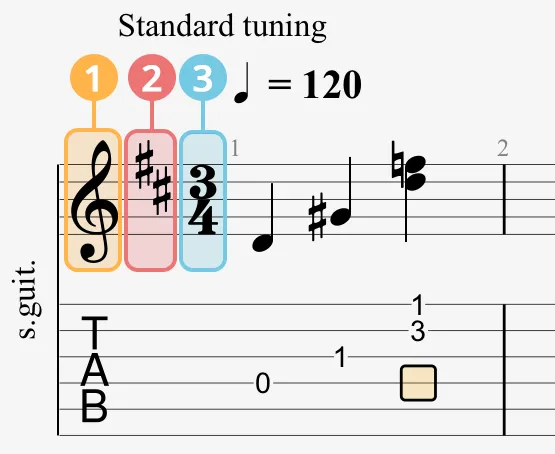
Each score begins with three fundamental elements: the clef, the key signature, and the time signature.
Clef: Determines the pitch of notes on the staff.
- Treble clef: Places the G note on the second line from the bottom. Commonly used for guitar.
- Bass clef: Places the F note on the second line from the top. Used for low-pitched instruments.
- C clef (alto/tenor): Less common for guitar, used for certain transposing instruments.
- Treble clef: Places the G note on the second line from the bottom. Commonly used for guitar.
Key signature: Indicates the sharps (#) or flats (b) applied throughout the piece. Example: C major has no sharps or flats, G major has one sharp (F#).
Time signature: Defines the rhythmic structure of the score.
- 4/4 (common time): four quarter-note beats per bar. Very common in popular music.
- 3/4: three quarter-note beats per bar, typical of waltzes.
- The top number indicates the number of beats per bar, the bottom number indicates the beat unit (for example, 4 = quarter note).
- 4/4 (common time): four quarter-note beats per bar. Very common in popular music.
Chords
Chords are groups of three or more notes played simultaneously, forming harmony.
- Start with the root note (e.g., C).
- Add the third: E for a major chord, Eb for a minor chord.
- Add the fifth: G to form a basic triad.
Guitar Pro uses English note names. Reference:
| English | Romance Languages |
|---|---|
| A | La |
| B | Si |
| C | Do |
| D | Re |
| E | Mi |
| F | Fa |
| G | Sol |
To enrich chords:
- Extensions: seventh (e.g., B for C maj7), ninth, etc.
- Alterations: sharps (#) or flats (b) applied to these notes.
Guitar Pro 8 allows you to experiment easily with these variations thanks to its built-in chord engine.