
Repeat Signs, Alternate Endings and Directions in Guitar Pro 8
Understanding the concepts of directions, repeat signs, and alternate endings can be challenging if you are not fully familiar with music notation.
Guitar Pro allows you to edit these direction, repetition, and alternate ending symbols in your scores.
Repeat signs and direction symbols enable you to shorten the length of a score, by indicating sections to be replayed or groups of measures to be repeated a certain number of times. Alternate endings refine this process by specifying which measures to play during specific passes.
The benefit is twofold, as it reduces the number of measures to input and also the number of pages to print.
Guitar Pro’s audio engine, like a performer of a piece, must then unfold the score to play the measures in an orderly manner.
Repeat Signs
Repeat signs, known as repeat open and repeat close, allow you to repeat a section of your score a certain number of times.
Visually, they are represented by a double bar followed or preceded by two dots and are accessible from the Editing Palette via the following icons or from the Measure menu.
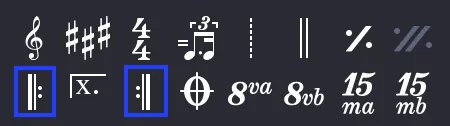
When you wish to repeat a group of measures, you need to delimit the group to be repeated. These repeat signs will serve as markers in a way.
Place a repeat open sign in the first measure of the group to repeat, and a repeat close sign in the last measure.
The number of passes is indicated above the repeat close sign.
In the example below, a repeat close sign has been placed at measure B with 3 repetitions applied.

The reading sequence is therefore: measure A-B-A-B-A-B-C
When there are only two passes to repeat, the number of passes is not displayed.
Depending on the repetitions and redirects to follow in your score, it is not always necessary to apply a repeat open sign for the first measure of your score.
Nested Repetitions: Repetitions can also be nested, as illustrated in the sequence below:

Here the reading sequence will be: A-B-B-C-A-B-B-C-A-B-B-C
Note that multiple repeat close signs can point to the same repeat open sign, as shown in the example below:

Here the reading sequence will be: A-A-B-A-A-B-C-A-A-B-A-A-B-C-A-A-B-A-A-B-C
As you can see, applying repeat signs within your measures can significantly alter the reading sequence of your score. Therefore, ensure they are applied correctly to achieve the desired final result.
Alternate Endings
Alternate endings are accessible from the Editing Palette via the following icon.
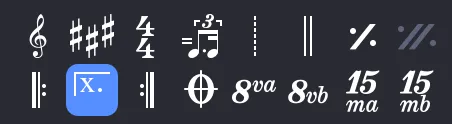
Alternate endings allow you to indicate, during repetitions, which measure should be played or ignored for a given pass.
To this end, depending on your selection, a number is placed above the concerned measure, indicating during which pass the measure should be played.
The number of passes ranges from 1 to 8.
In the example below, measure B will be played only during the first pass, ignored during the second. Measure C will be played during the second pass.

The reading sequence is therefore: A-B-A-C
In the following example, identify during which passes the measures should be played or ignored:

This sequence breaks down into 4 passes:
First pass: A - B
Second pass: A - C (B is ignored)
Third pass: A - B (C is ignored)
Fourth pass: A - D (B and C are ignored)
The complete reading sequence for this example will therefore be: A-B-A-C-A-B-A-D
Repetitions are implicitly extended. This means that as soon as a measure includes an alternate ending, the following measures are part of the same repetition.

In the example above, C will be played right after B during the first pass. The reading sequence will be: A-B-C-A-D
Directions
Direction options and settings are accessible from the Measure menu or from the Editing Palette via the following icon.
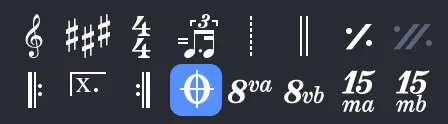
Directions allow you to jump from one measure to another within the piece.
To do this, you must place targets (or return signs) in your score and jump indications to which they are linked.
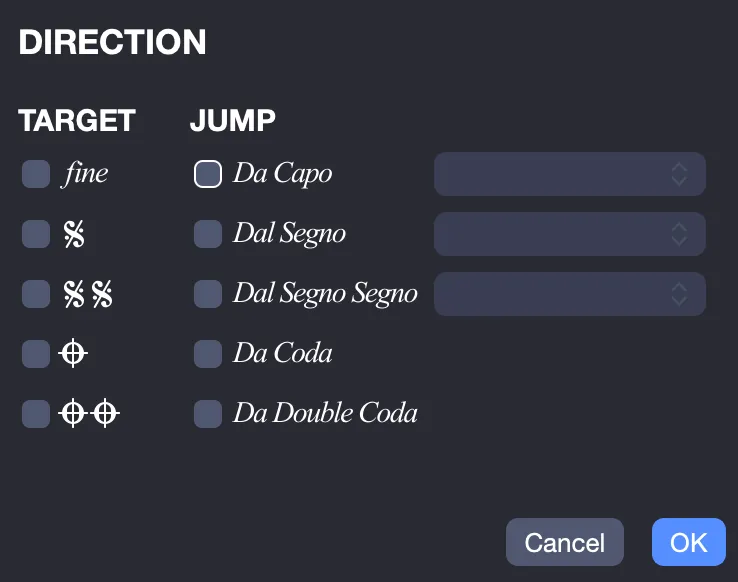
Da Capo
The Da Capo jump indicates that the reading path should resume from the beginning of the score as soon as you encounter the Da Capo indication.

Reading sequence: A-B-C-A-B-C
Note that when the piece includes an anacrusis, the jump occurs to the second measure, with the first measure played only once.
Dal Segno
The Dal Segno jump, also noted as Da Segno or D.S, refers to the measure containing the Segno target, symbolized by an S with two dots.
You must therefore ignore the Segno symbol during the first pass and return to it as soon as you encounter the Dal Segno indication.
In the following example, the Segno target has been placed at measure B and the Dal Segno jump at measure C.

The reading sequence is therefore: A-B-C-B-C
Dal Segno Segno
Similar to the Dal Segno jump, the Dal Segno Segno jump refers to the measure containing the Segno Segno target. The jump occurs provided a Segno jump has already been made or in its absence.

Reading sequence: A-B-C-B-C
Note that within a repeated section, the Dal Segno (Segno) jump occurs during the last pass.
Da Coda
The Coda symbol indicates the final part of a piece. It represents the outro, as opposed to the introduction.
This section, consisting of one or more measures, is detached from the rest of the score.
The instruction to go to the Coda symbol is given with the annotation Da Coda (or Al Coda, To Coda).
The Da Coda jump refers to the measure containing the Coda symbol.

Reading sequence: A-C.
B is ignored since the Da Coda annotation encountered at measure A makes us jump to measure C.
Note that within a repeated section, the jump occurs during the first pass.
The Da Coda jump becomes active and must be interpreted only when it has been previously activated by a jump with the instruction « Al Coda ». In the absence of an « Al Coda » instruction in the score, it is automatically activated the last time it is encountered.
Da Double Coda
Same as Da Coda.

Reading sequence: A-C
Fine
The Fine indicates the true end of the piece and often works in pair with Da Capo.

The stop occurs provided a jump has already been made.

Reading sequence: A-B-C-D-A-B
Miscellaneous
Segno signs are generally used for backward jumps and Coda signs for forward jumps.
In musical literature, you will not encounter a Segno or Coda sign without a corresponding Da Segno or Da Coda jump.
The use of “Al Fine / Al Coda / Al Double Coda” will force the interpretation of the Fine / Coda / Double Coda at the next encounter. In the absence of this, the last occurrence will be interpreted.
A multitude of examples and various situations are possible, for more information we refer you to music theory books. Nevertheless, feel free to contact our Support if necessary.