Discovering Numbered Notation or Jianpu in Guitar Pro 8
Since Guitar Pro 8.1, Numbered Notation (Jianpu) is available. You can select it in the Track Inspector, alongside standard notation, tablature, and rhythmic (slash) notation:
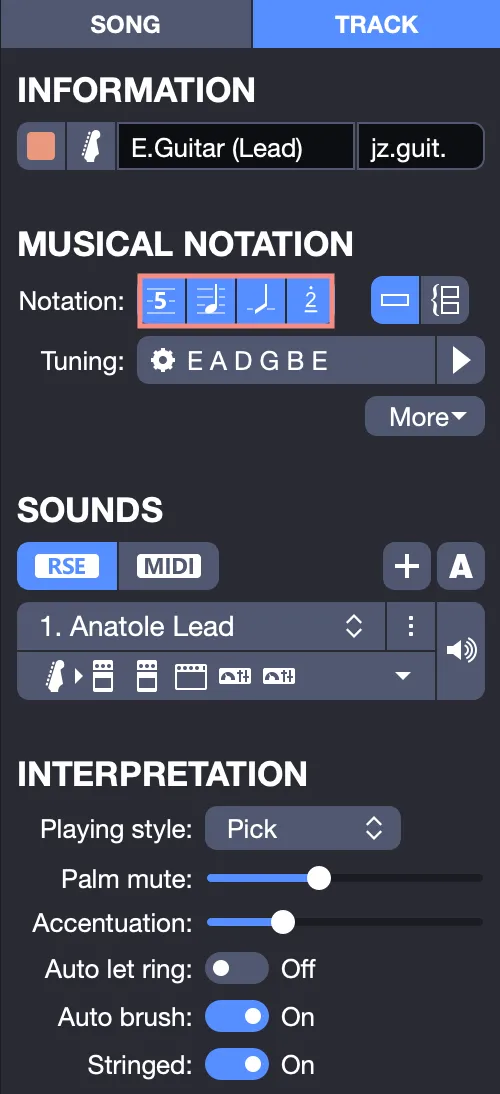
This fourth type of notation, available for non-percussion instruments, represents notes using numbers from 1 to 7, with 0 representing a rest. Just like rhythmic notation, it displays only one note at a time. The number 1 corresponds to the tonic, based on the key signature.
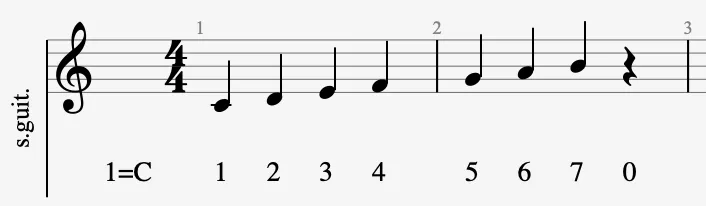
The key is shown as 1 = C (or 1 = A for a minor key).
Jianpu Equivalence in C Major
| Number | Note | Scale Degree |
|---|---|---|
| 1 | C | Tonic |
| 2 | D | Supertonic |
| 3 | E | Mediant |
| 4 | F | Subdominant |
| 5 | G | Dominant |
| 6 | A | Submediant |
| 7 | B | Leading Tone |
| 0 | – | Rest |
Note Durations
For values longer than a quarter note, hyphens are added to the right of the number:
| Representation | Duration |
|---|---|
| 1 | Quarter note |
| 1 - | Half note |
| 1 - - | Dotted half note |
| 1 - - - | Whole note |
| 1 - - - - | Dotted whole note |
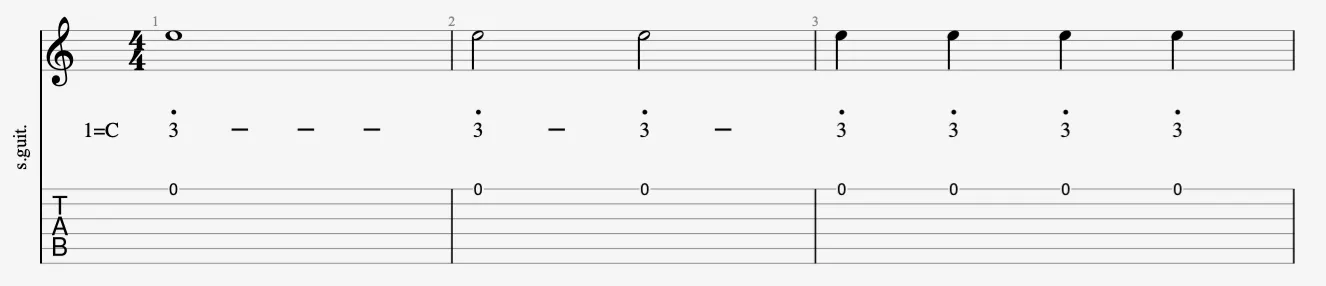
For durations shorter than a quarter note, descriptions replace underlines:
| Representation | Duration |
|---|---|
| 1 (underlined once) | Eighth note |
| 1 (underlined twice) | Sixteenth note |
| 1 (underlined three times) | Thirty-second note |
| 1 (underlined four times) | Sixty-fourth note |
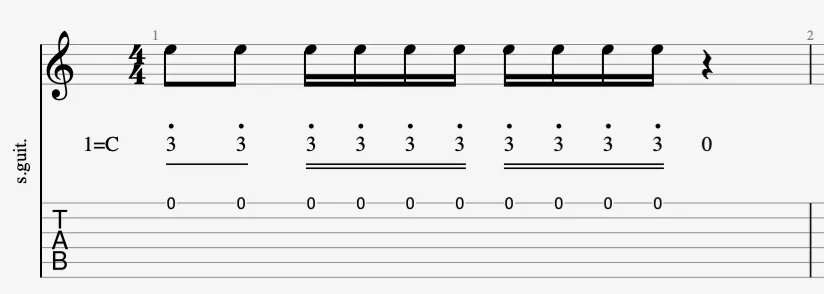
Rests follow the same principle as notes (e.g., 0 (underlined twice) for a sixteenth rest).
| Standard Notation | Jianpu Representation | Duration |
|---|---|---|
 |
1 - - - | Whole note |
 |
1 - | Half note |
 |
1 | Quarter note |
 |
1 (underlined once) | Eighth note |
 |
1 (underlined twice) | Sixteenth note |
 |
1 (underlined three times) | Thirty-second note |
 |
1 (underlined four times) | Sixty-fourth note |
Octaves
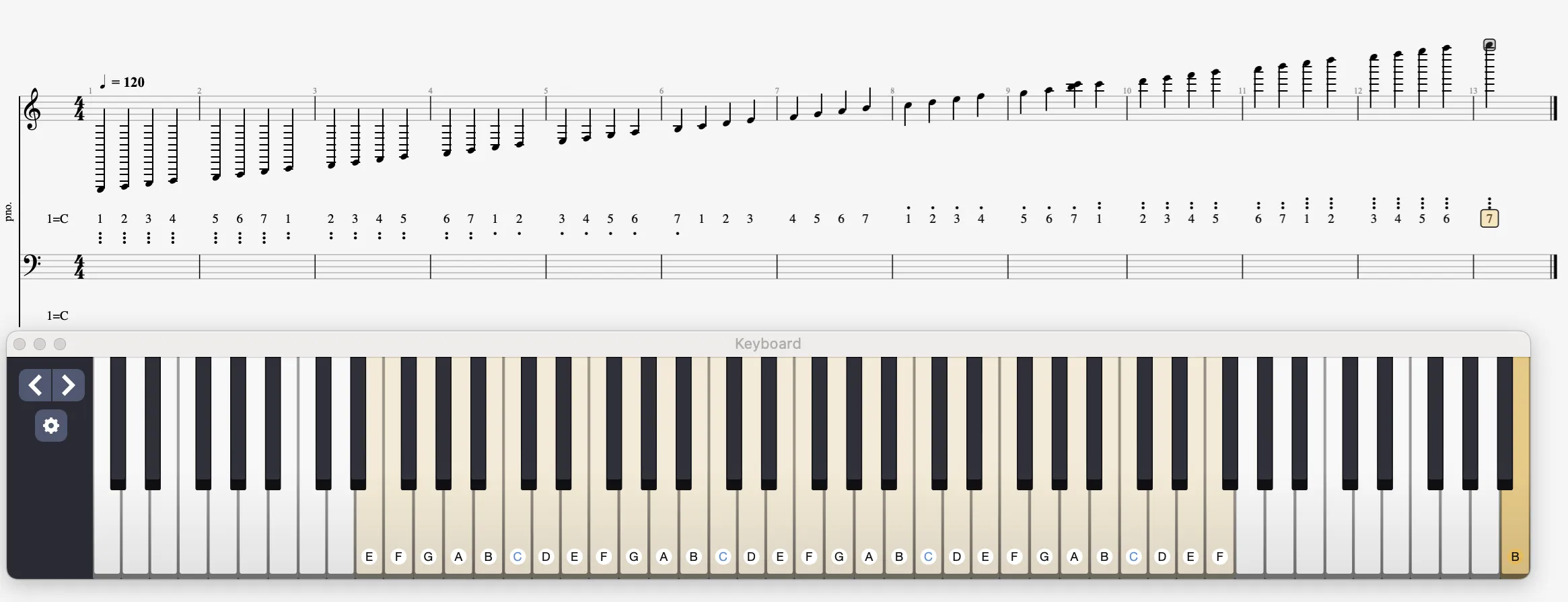
Dots above or below the numbers indicate octave shifts. The image below shows the seven octave ranges across a keyboard:
Accidentals
Accidentals work differently than in standard notation.
- In C major, which has no accidentals,
#1means C♯. - In E♭ major, which has three flats,
1already represents E♭, so a natural E is notated as#1.
There is no natural sign (♮) in Jianpu. All accidentals are shown using # or b.
Elements Displayed with Jianpu
The following elements are supported and visible in Jianpu notation:
- Tuplets (e.g., triplets)
- Slurs (including hammer-ons, pull-offs, legatos)
- Accents
- Ornaments (trills, grace notes)
- Lyrics
- Fingerings
- Fermatas
These enrich the expression and interpretation of the score.
Preview Example
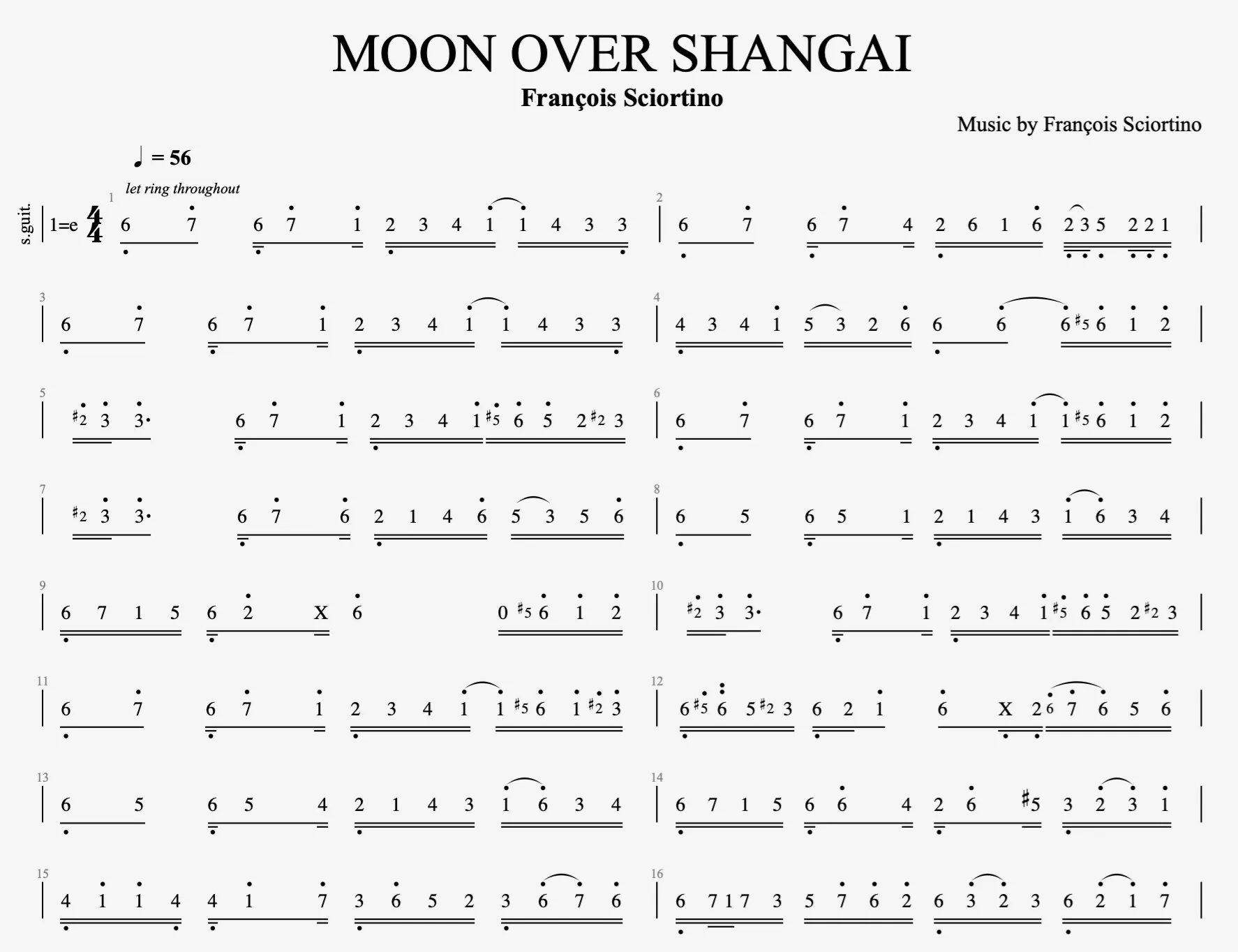
Here is an example of a full score using Jianpu notation only: